


PABX vs VoIP for Dubai Offices: The Honest Comparison You Actually Need
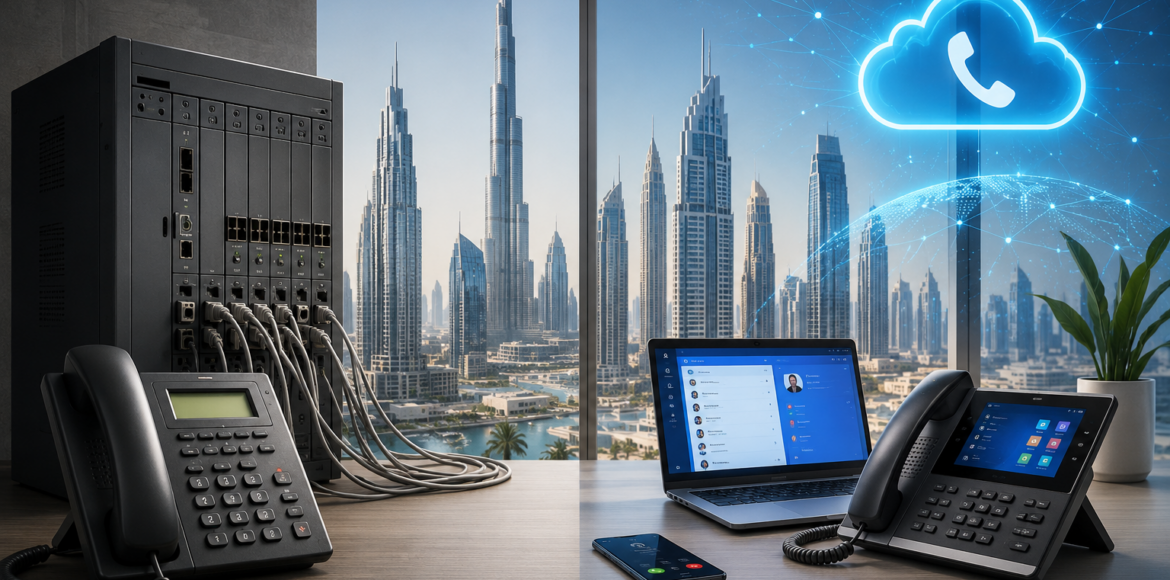
There’s a high probability that you’ll discover PABX equipment attached to the server room wall in any Dubai business that was established prior to 2018, quietly routing calls in the same manner as it has for years. Nobody thinks much about it. It works. Why change it?
Now, enter a workplace in Dubai that was established within the previous three years, and you will notice a significant difference. IP phones on the desks, softphone apps on laptops, calls routing over the internet, and the whole system managed from a browser.
Both are phone systems. That is roughly where the similarity ends. Here is how they actually compare for a Dubai business in 2026.
PABX: What It Is and How It Works
PABX stands for Private Automatic Branch Exchange. It is a tangible piece of hardware that sits in your server room and manages all internal extensions and external calls. It is usually a box the size of a thick briefcase.
Conventional PABX uses telephone wiring that is specifically installed throughout the building. Keep your data network apart. Every desk phone has a separate phone connection that connects to the PABX equipment. The system works entirely independently of your internet connection, which is both a strength and a limitation.
VoIP: What It Is and How It Works
VoIP converts voice into data packets and sends them over your existing Ethernet network. Your phone calls are carried by the same Cat6A cabling that transports your internet data. There is no need for additional phone wiring.
In Dubai offices, two primary formats are utilized.
There are two main configurations used in Dubai offices.
- IP-PBX: An on-premise VoIP server or appliance manages all call routing internally. External calls go through SIP trunks from a licensed UAE VoIP provider. Your data, your control.
- Hosted VoIP: The entire PBX lives in the cloud. IP phones on the desks connect to the cloud system over the internet. Zero on-site telephony hardware beyond the handsets themselves.
Direct Comparison: What Matters for a Dubai Office
| Factor | Traditional PABX | VoIP or IP-PBX |
| Cabling required | Dedicated phone wiring throughout | Uses existing Cat6A data cabling |
| Internet dependency | Works without internet | Needs reliable internet for external calls |
| Upfront hardware cost | AED 15,000 to 50,000 plus | AED 5,000 to 15,000 for IP phones and configuration |
| Monthly line costs | AED 500 to 2,000 via du or Etisalat | AED 100 to 500 via SIP trunks |
| International call costs | AED 0.50 to 2.00 per minute | AED 0.05 to 0.30 per minute |
| Remote worker support | Expensive hardware extension | Free softphone app on any laptop or phone |
| Teams or CRM integration | Very limited or impossible | Native integration available |
| Adding new extensions | Requires hardware upgrade | Takes about five minutes in the software |
| 5-year total cost (20 users) | AED 55,000 to 100,000 | AED 25,000 to 55,000 |
When Traditional PABX Still Makes Sense
PABX is not outdated in every scenario. There are situations where keeping it or installing it new is the right decision.
- You run a call center operation with 50 or more concurrent calls, and absolute reliability is non-negotiable. PABX running over dedicated lines does not care about your internet.
- Your existing PABX was installed recently and is in good working order. Replacing functioning infrastructure before end-of-life rarely makes financial sense.
- Your office is in a location with genuinely unreliable internet. Some industrial areas and older buildings in Dubai still have connection quality that would make VoIP unreliable.
- Your business has very specific call recording or compliance requirements that your preferred VoIP provider cannot meet.
When VoIP Is the Right Call for a Dubai Office
For the majority of new Dubai office setups and businesses thinking about upgrading their phone system, VoIP wins on almost every dimension.
- You are setting up a new office. Installing PABX in a new space means buying and running separate phone cabling throughout the building. With VoIP, you use the Cat6A cabling you are already installing for data. The saving is immediate.
- Your team includes remote workers or people who travel regularly. A VoIP softphone app gives them a full office extension on their laptop from anywhere in the world. The equivalent on a PABX requires buying and shipping hardware.
- You use Microsoft Teams or any modern CRM. VoIP systems can be integrated natively. Calls logged automatically. Click to dial. Teams calling through your office number. PABX cannot do any of this without expensive third-party hardware.
- International calls are a regular part of your business. VoIP rates for UAE and international calls are dramatically lower than PSTN rates.
- Your business is growing. Adding a new extension to VoIP takes minutes and costs almost nothing. On PABX, it requires hardware.
|
Teclonex recommendation for new Dubai office setups in 2026 For any new office or any business looking to upgrade, VoIP or IP-PBX is the right choice in almost every case. The combination of lower installation cost, no separate cabling, remote work capability, and modern integrations makes it the clear winner. The only exception is where internet reliability genuinely cannot be guaranteed. |
|
Need a Phone System for Your Dubai Office? Teclonex installs PABX and VoIP phone systems for Dubai businesses of all sizes. Free assessment of your requirements and a no-obligation quotation. WhatsApp: +971 54 219 6496 Email: info@teclonex.com Web: teclonex.com/it-infrastructure-service/ |
Frequently Asked Questions
Q: Can I keep my existing phone numbers if I switch to VoIP?
A: Yes. Number porting is available in the UAE and lets you transfer your existing du or Etisalat numbers to a VoIP SIP trunk provider. The porting process typically takes two to four weeks and may involve a brief period where the number is forwarded from the old line to the new setup. Teclonex manages this process as part of every VoIP installation.
Q: What happens to calls if the internet goes down?
A: External calls on VoIP require an active internet connection. For business-critical setups, we configure two protections: a 4G or 5G backup router that activates automatically when the primary line fails and call forwarding rules that redirect incoming calls to mobile numbers if the VoIP server becomes unreachable. Both are standard on Teclonex VoIP installations.
Q: Is VoIP legal in the UAE?
A: Business VoIP using licensed UAE telecommunications providers and registered SIP trunks from du Business or Etisalat Business is fully legal and widely used across Dubai. Consumer applications like Skype are regulated differently in the UAE. Teclonex only uses licensed, UAE-compliant VoIP providers.
Q: How many concurrent phone lines does my Dubai office need?
A: A good rule of thumb is 20 to 30 percent of your total headcount as the number of simultaneous external calls. A 20-person office typically needs four to six concurrent lines. VoIP SIP trunks are priced per concurrent call, so you pay for exactly what you use, and adding more capacity is instant and inexpensive.
Q: Can VoIP integrate with Microsoft Teams?
A: Yes. Microsoft Teams direct routing allows your VoIP system to handle calls through the Teams interface. Staff can make and receive office calls from within Teams using their existing desk or laptop. It works well, and most modern Dubai businesses with Teams already deployed find it the most natural setup. Teclonex configures Teams direct routing as part of VoIP projects.